
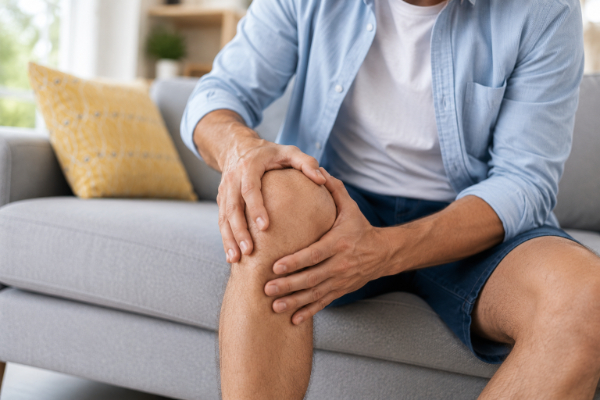
Knee Pain Treatment in Irving TX
Identify the Cause. Treat It Precisely. Avoid Surgery When Possible.
⭐⭐⭐⭐⭐ 456 Five-Star Reviews · 30 Years · 30,000+ Patients · Irving & Las Colinas TX
Knee pain is one of the most common conditions we treat — and one of the most frequently mismanaged. Too often patients are offered cortisone injections, told to manage with anti-inflammatories, or referred for surgery without a thorough evaluation of the structural and biomechanical contributors driving their knee condition.
At Ethos Medical Group, Longevity and Wellness, Dr. Jason Black identifies the exact cause of your knee pain — whether it originates in the knee itself, the hip, the lumbar spine, or the foot and ankle — and builds a precise treatment plan to correct it without injections or surgery in most cases.
As Seen On:



Why Accurate Diagnosis Is Everything for Knee Pain
The knee is a complex joint — a hinge between the femur and tibia, stabilized by four major ligaments, cushioned by two menisci, supported by the patella and its tendon, and dependent on the hip and lumbar spine for proper biomechanical function. Pain can arise from any of these structures individually or in combination.
What makes knee pain particularly important to evaluate thoroughly is that the knee is frequently a victim of dysfunction elsewhere. Hip weakness causes the femur to rotate inward, increasing stress on the medial knee. Flat feet alter tibial rotation, stressing the meniscus. Lumbar nerve root compression at L3 or L4 refers pain directly into the knee. Treating the knee without evaluating these upstream contributors produces temporary relief at best.
Dr. Black’s approach addresses the knee and every structure that influences it — producing outcomes that purely local knee treatment cannot achieve.
Dr. Jason Black’s Approach to Knee Pain
Knee Conditions We Treat
- Patellar Tendinopathy (Jumper’s Knee) — degeneration and inflammation of the patellar tendon from repetitive jumping, running, and squatting
- Patellofemoral Pain Syndrome (Runner’s Knee) — pain behind or around the kneecap from abnormal patellar tracking and cartilage stress
- Chondromalacia Patella — softening and breakdown of the articular cartilage on the underside of the kneecap causing pain and grinding
- IT Band Syndrome — lateral knee pain from iliotibial band friction, common in runners, cyclists, and hikers
- Meniscal Tears — tears of the medial or lateral meniscus from acute injury or degenerative wear, causing pain, swelling, locking, and clicking
- ACL, PCL, MCL, and LCL Sprains and Tears — ligament injuries from contact, cutting, and twisting mechanisms causing instability and pain
- Knee Osteoarthritis — degenerative joint disease causing progressive pain, stiffness, swelling, and loss of function
- Pes Anserine Bursitis — inflammation of the bursa on the medial aspect of the knee, common in runners and patients with osteoarthritis
- Prepatellar Bursitis — inflammation of the bursa over the kneecap from kneeling occupations and direct trauma
- Baker’s Cyst (Popliteal Cyst) — fluid-filled cyst behind the knee, typically secondary to intra-articular pathology such as meniscal tear or arthritis
- Osgood-Schlatter Disease — apophysitis at the tibial tubercle in adolescent athletes causing anterior knee pain and swelling
- Plica Syndrome — irritation of the synovial plica fold causing medial knee pain and snapping, often misdiagnosed
- Osteochondritis Dissecans — separation of bone and cartilage from the femoral condyle, seen in adolescents and young adults
- Gout and Pseudogout — crystal arthropathy causing acute or chronic knee inflammation and pain
- Referred Knee Pain from Lumbar Spine — L3 and L4 nerve root compression referring pain into the anterior and medial knee
- Hip-Driven Knee Pain — medial knee stress and pain from hip abductor weakness and femoral internal rotation
How We Evaluate Knee Pain at Ethos
Dr. Jason Black personally conducts every knee evaluation. Our examination is designed to identify the exact structural source of your knee pain — at the knee and at every structure influencing knee biomechanics.
Your evaluation includes:
- Detailed History: Onset, mechanism, sport or occupation, swelling history, locking or giving way episodes, prior treatments, and prior imaging.
- Knee Orthopedic Testing: Lachman test, anterior and posterior drawer tests, McMurray test, Thessaly test, valgus and varus stress tests, patellar grind, Clarke’s sign, and Ober’s test to identify specific structural pathology.
- Hip and Lumbar Assessment: Evaluation of hip abductor and external rotator strength, lumbar nerve root testing, and hip mobility to identify upstream contributors to knee pain.
- Foot and Ankle Assessment: Evaluation of arch structure, subtalar pronation, and ankle dorsiflexion affecting tibial rotation and knee mechanics.
- Functional Movement Assessment: Single-leg squat, step-down, and gait analysis to identify dynamic valgus, hip drop, and movement pattern dysfunction driving knee stress.
- Digital X-Rays (when indicated): On-site imaging to assess joint space, alignment, and bony pathology — available for $95 when clinically necessary.
- MRI Review: If you have existing knee MRI, Dr. Black will review it and correlate imaging findings with your clinical presentation.
How Ethos Treats Knee Pain
Our Ethos Stacked Care™ model addresses the knee injury, the surrounding soft tissue, and the biomechanical chain driving knee stress:
- Class IV Medical Laser Therapy — accelerates tendon and ligament healing, reduces intra-articular inflammation, stimulates cartilage repair, and relieves knee pain at the cellular level. Highly effective for patellar tendinopathy, osteoarthritis, and meniscal irritation
- PiezoWave Sound Wave Therapy — breaks down patellar tendinopathy, IT band adhesions, and chronic bursitis that do not respond to manual therapy. The most effective tool for chronic tendinopathy and calcific deposits in the knee
- Chiropractic Joint Manipulation — precise adjustments to the tibiofemoral joint, patellofemoral joint, proximal tibiofibular joint, hip, and lumbar spine to restore proper mechanics and relieve nerve irritation contributing to knee pain
- Active Release Technique — addresses IT band restrictions, quadriceps adhesions, hamstring tightness, and popliteal soft tissue that alter knee tracking and loading
- Corrective Exercise and Knee Rehabilitation — targeted hip strengthening, VMO activation, patellar tracking correction, and functional movement retraining to eliminate the biomechanical contributors driving your knee condition
- Regenerative Medicine — for appropriate candidates, prolotherapy and regenerative options to support ligament and cartilage repair in knee conditions not fully resolving with conservative care
- Medical-Grade Nutritional Support — collagen synthesis support, anti-inflammatory protocols, and joint health supplementation to support cartilage repair and reduce chronic knee inflammation
What to Expect from Knee Pain Treatment at Ethos
What Our Knee Patients Experience
- Precise identification of every structural contributor to their knee pain
- Significant reduction in pain and swelling — often within the first several visits
- Improved knee stability and confidence with movement
- Correction of the hip, foot, and spinal mechanics driving knee stress
- Return to running, sport, stairs, and daily activities without pain
- Avoidance of cortisone injections and knee surgery in most cases
- Long-term relief — not temporary suppression of symptoms
Is Ethos Right for Your Knee Pain?
We treat knee conditions across the full spectrum — from acute sports injuries to chronic degenerative conditions. You may be a strong candidate if:
- You have knee pain that has lasted more than a few weeks
- You have swelling, clicking, locking, or giving way in the knee
- You have been diagnosed with osteoarthritis, a meniscal tear, or tendinopathy
- Running, stairs, squatting, or prolonged sitting aggravates your knee
- You have been recommended for cortisone injection or knee surgery
- Prior physical therapy has not produced lasting relief
- You are an athlete with knee pain limiting your training or competition
The best first step is a complimentary consultation with Dr. Black. You will leave with a clear diagnosis and a precise plan — not a referral for imaging and a follow-up appointment six weeks away.
Real Patients. Real Results. Hear What They Have to Say.
Knee Pain Limiting Your Life? Get a Precise Evaluation Today.
Book a complimentary consultation with Dr. Jason Black — 30 years · 30,000+ patients · Irving TX.
Most of our knee patients avoid cortisone injections and surgery. Find out if you can too.
Request an Appointment (972) 409-0016
📍 300 E Royal Ln #110, Irving TX 75039 | Monday–Thursday 7:30am–6:00pm


