Disc Injury Treatment in Irving TX
Herniated Disc. Bulging Disc. Degenerative Disc Disease. Treated Without Surgery.
⭐⭐⭐⭐⭐ 456 Five-Star Reviews · 30 Years · 30,000+ Patients · Irving & Las Colinas TX
Spinal disc injuries are among the most common and most mismanaged conditions in modern medicine. Patients are told to rest, given anti-inflammatories, offered injections, and ultimately referred for surgery — often without ever addressing the structural cause of disc failure.
At Ethos Medical Group, Longevity and Wellness, Dr. Jason Black has spent 30 years developing precise, non-surgical protocols that decompress damaged discs, restore disc height, relieve nerve pressure, and produce lasting structural improvement — in most cases eliminating the need for surgery entirely.
As Seen On:



Understanding Spinal Disc Injuries
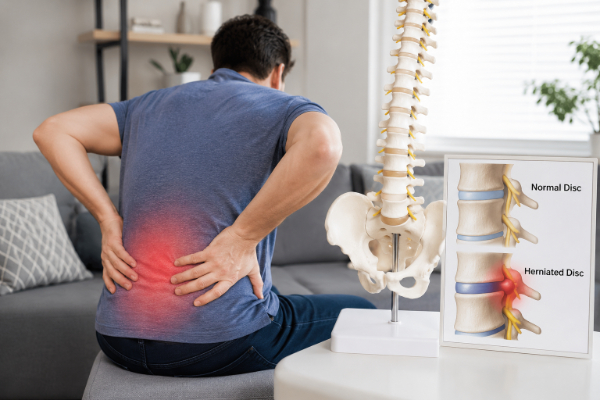
The intervertebral discs are the shock-absorbing structures between each vertebra in your spine. They are composed of a tough outer ring (annulus fibrosus) and a gel-like inner core (nucleus pulposus). When the outer ring weakens or tears, the inner material can bulge or herniate outward — compressing adjacent nerve roots and producing pain, numbness, tingling, and weakness.
Disc injuries exist on a spectrum — from mild dehydration and early degeneration to full herniation with severe nerve compression. What they have in common is that all disc conditions worsen over time without treatment that addresses the underlying structural failure. Surgery removes disc material but does not restore disc health. The structural environment that caused the disc to fail in the first place remains unchanged.
Dr. Black’s approach targets that environment — restoring disc hydration, relieving nerve compression, correcting spinal mechanics, and building the stability needed to prevent recurrence.
Dr. Jason Black’s Approach to Disc Injuries
Types of Disc Conditions We Treat
- Disc Herniation — the nucleus material pushes through a tear in the annulus, compressing nerve roots and producing radiating pain, numbness, and weakness
- Disc Bulge — the outer disc wall weakens and bulges outward without fully rupturing, causing nerve irritation and local or radiating pain
- Degenerative Disc Disease — progressive loss of disc height, hydration, and structural integrity causing chronic pain, stiffness, and nerve compression
- Disc Extrusion — severe herniation where the nucleus material breaks free from the disc, requiring precise conservative management before surgical consideration
- Annular Tear — tearing of the outer disc ring causing localized pain and creating a pathway for future herniation
- Spinal Stenosis from Disc Collapse — disc height loss causing narrowing of the spinal canal or foraminal openings, compressing the spinal cord or nerve roots
- Post-Surgical Disc Pain — recurrent disc problems or adjacent segment degeneration following prior spinal surgery
Every disc condition has a specific mechanism and requires a specific treatment approach. Generic protocols produce generic results.

How We Evaluate Disc Injuries at Ethos
Dr. Jason Black personally conducts every disc injury evaluation. Our examination is designed to identify the exact disc level involved, the degree of nerve compression, and the structural factors driving disc failure — before recommending any treatment.
Your evaluation includes:
- Detailed History: Onset, mechanism of injury, symptom location and character, prior imaging, prior treatments, and red flag screening.
- Chiropractic and Orthopedic Examination: Segmental spinal assessment, disc provocation testing, and joint mobility evaluation to identify the affected level.
- Neurological Testing: Reflex testing, dermatomal sensory mapping, and muscle strength testing to identify nerve root involvement and compression severity.
- Digital Postural Analysis: Identification of spinal imbalances and postural contributors to disc loading and failure.
- Range of Motion Analysis: Precise measurement of motion deficits and pain provocation patterns.
- Digital X-Rays (when indicated): On-site imaging to assess disc height, alignment, and degenerative changes — available for $95 when clinically necessary.
- MRI Review: If you have existing MRI imaging, Dr. Black will review it as part of your evaluation to correlate imaging findings with your clinical presentation.
- Thermography: Infrared nerve mapping to document the level and extent of neurological involvement.
Following your evaluation, Dr. Black will explain exactly which disc is involved, what is causing your symptoms, and whether you are a candidate for our non-surgical disc protocols.
How Ethos Treats Disc Injuries
Our Ethos Stacked Care™ model delivers the most advanced non-surgical disc treatment available — targeting the disc itself, the compressed nerve, the surrounding soft tissue, and the spinal mechanics driving disc failure.
Non-Surgical Spinal Decompression
The cornerstone of our disc treatment program. Computerized spinal decompression applies precise, targeted traction forces that create negative intradiscal pressure — drawing herniated or bulged disc material back toward center, rehydrating degenerated discs, and relieving compression on nerve roots. This is the most clinically validated non-surgical treatment for disc herniation and degenerative disc disease available today. Far more precise and effective than manual traction.
Class IV Medical Laser Therapy
FDA-cleared photobiomodulation therapy delivered directly to the affected disc level and nerve root. Stimulates cellular repair within the disc annulus, reduces neuroinflammation, accelerates healing of annular tears, and relieves nerve pain. Works synergistically with decompression to produce faster and more complete disc recovery.
Chiropractic Adjustments
Precise spinal adjustments restore proper segmental alignment and joint mechanics — reducing the asymmetric loading forces that caused disc failure and preventing further degeneration. Dr. Black uses low-force, instrument-assisted techniques that are safe even in the acute disc herniation phase.
PiezoWave Sound Wave Therapy
Acoustic wave technology targeting myofascial spasm, scar tissue, and chronic inflammation in the paraspinal musculature surrounding the injured disc. Reduces the muscular guarding and fascial restriction that maintains abnormal disc loading and impairs recovery.
Soft Tissue Therapy — MFR and ART
Myofascial Release and Active Release Technique address the soft tissue contributors to disc injury — releasing paraspinal adhesions, restoring fascial mobility, and correcting the muscular imbalances that perpetuate abnormal spinal mechanics.
Corrective Exercise and Spinal Stabilization
Condition-specific rehabilitation targeting the deep spinal stabilizers, posterior chain, and core musculature responsible for protecting disc integrity. Designed around your specific disc level and spinal mechanics — not generic back exercises that can worsen disc conditions when applied incorrectly.
Medical-Grade Nutritional Support
Targeted supplementation to reduce disc inflammation, support annular repair, promote collagen synthesis within the disc structure, and provide the nutritional substrates needed for disc rehydration and healing.
What to Expect from Disc Injury Treatment at Ethos
What Our Disc Patients Experience
- Identification of the exact disc level involved and the structural cause of failure
- Significant reduction in local and radiating pain — often within the first several visits
- Progressive reduction in nerve compression symptoms — numbness, tingling, weakness
- Measurable improvement in disc height and hydration over the course of treatment
- Restored spinal mechanics that protect the disc from re-injury
- Avoidance of epidural injections and spinal surgery in most cases
- Return to normal activity — work, exercise, and daily life without constant pain
Is Ethos Right for Your Disc Condition?
We treat disc injuries across the full spectrum — from early degeneration to severe herniations with significant nerve compression. You may be a strong candidate if:
- You have been diagnosed with a herniated disc, bulging disc, or degenerative disc disease
- You experience pain that radiates into your arm or leg from a disc compression
- You have been recommended for epidural injections or surgery
- Prior physical therapy or chiropractic has not produced lasting relief
- You are seeking a second opinion before proceeding with invasive treatment
- Your symptoms have been present for more than a few weeks and are not improving
The best way to determine candidacy is a thorough evaluation with Dr. Black. You will leave with a clear understanding of your disc condition and whether our protocols are appropriate for your specific case.
Real Patients. Real Results. Hear What They Have to Say.
Have a Disc Problem? Get a Precise Evaluation Before Considering Surgery.
Book a complimentary consultation with Dr. Jason Black — 30 years · 30,000+ patients · Irving TX.
Most of our disc patients avoid surgery entirely. Find out if you can too.
Request an Appointment (972) 409-0016
📍 300 E Royal Ln #110, Irving TX 75039 | Monday–Thursday 7:30am–6:00pm


